February, 2019 Blog 1 Hello Mentors, I have been very busy getting the podcast up and going. The first one was published last week. I had a wonderful conversation withe David Boulton, world renown educator, producer, researcher, developer of all things related to working with struggling students. The podcast is called Mentorships in Education and is sponsored by my business, Just Education, LL at justeducationfirst.com. I encourage you to visit his website at learningstudards.org and read about the amazing work he has done and is doing. Check out Magic Ladders and then go to childrenofthecode.org and view the videos on working with students with experts in the field from all over the world. If you have not heard of him, please let me know what you think of the information you have learned. And please listen to my conversation with David at http://www.buzzsprout.com/251698/939602-mentorships-in-education-with-david-boulton My goal is to provide a fr...
Posts
January 2019, Blog Two Do you know where the word “discipline” comes from? It came from the word “disciple” which means a follower; one who believes in the teachings and wants to learn.. In my mind, our children are like our disciples and when we apply discipline, we should be teaching them our values and priorities. I am not sure how the word came to be equated with punishment. But it didn’t start out that way. On the other hand, going into long explanations is not supportive of the learning process. In fact, kids of all ages stop listening after the first few sentences and we lose them. All they hear is "Bla, Bla, Bla". So where is the productive middle between shouting out a punishment or a threat for repeated offences and spending time after each event reviewing the logic behind the requirement. I think we can all agree that if the behavior does not stop after threatening punishment or after institu...
Blog January 2019 Welcome back everyone! I hope you had a special holiday season filled with good food and those you love. We are going to pick up this year by extending some of the topics that were introduced last year. One way I will do that is to introduce a new component to our menu. I will be starting to do podcasting by the end of the month. I will be speaking to professionals around the country and the world who are graciously offering their time. The varied topics will be of interest to parents, teachers, students and anyone who works with students. I have always had a dream to make professionals available without the high hourly rates. We have such a wealth of information available to us, but often it is expensive to access it. I hope to provide a forum for knowledgeable and respected experts to introduce themselves, share their views and provide a basis of information, so that we can then move forward and...
Blog #8- Homework: final episode If you have had the discussion with your student and taken a week or so to brainstorm some approaches to support the homework struggle, and agreed on what approaches would be best to address first, you will be ready for the next step; Initiating the plan. Please keep in mind that this entire process is non-confrontational. Use Socratic questioning described is an earlier blog. Without attacking faulty reasoning, ask for the thought process that supports the conclusions. Make an attempt to understand the reasoning behind the conclusions. No meaningful change happens without a buy-in. Allowing your student to be part of the planning and decision-making process is the buy-in needed for long term changes. Possible choices for long term solutions: Creating a study area; A study area does not need to be in the bedroom. If a student shares a room or if the room is too small, t...
Blog #7 Homework Saga , Continued I recently found this and felt it was too good not to share given our current topic. The Parent's Homework Prayer Homework and I have irreconcilable differences. Please grant me the serenity to accept the Homework I can not change .......the courage to support my child to complete it the best I can .....and the strength to finish it without either of us ending up in a body bag. My guess is that, as parents, we have experienced these thoughts on more than one occasion. Let's review the first step, from the previous Blog, in addressing homework issues: Step one A -Mention to your student your concerns about homework and any observations you have on this topic. Share any communications from the teachers that relate. Ask your student his/her perspective on the topic. If the student does not agree that homework is a struggle, ask for their ...
Stop telling me what to do!
My "Summer" break lasted a little longer than I had planned. Unexpected events took priority and extra time. October is a good time, actually, to begin addressing some important issues. Homework is always a big concern about this time of year as teachers and parents grapple with kids who are not, for whatever reason, successful in following through with their home responsibilities. I thought I would start this year's blogs by putting out some tips for parents so they can better communicate with their students in a non-confrontational discussion to collaborate on how they can move forward and address some of the issues at hand. The worst approach is to point the finger and tell your student what they should and should not be doing. If your boss did that at work to you, what would your response be to him? I probably can't print it here.😊 The first step: to agree on and define the problem. I would suggest mentioning to your student th...
Blog 5-June, 2018 Cognitive Behavior Therapy, Collaborative Problem Solving (now called Collaborative Proactive Solutions) and Social Thinking all have some very important concepts that they share. Thoughts drive feelings which affect behavior Ones concept of Self (Bandura's self-efficacy) affects the decisions we make and how we interact with others If we feel we are being judged rather than being listened to, we are most likely not open to anything that person has to say (Rita Pierson and Ross Greene) Social thinking is the trade name for a protocol of behavior remediation used with kids on the spectrum. It is a wonderful approach which uses humor, practical applications and visual characters. Some of the most popular characters with my students are Superflex, Rock Brain, Glass Man, Wasfunnyonce and Worry Wall. The younger kids love it. The older kids can relate to the mirror that is held up of the character traits they are disp...
Blog 4-June, 2018
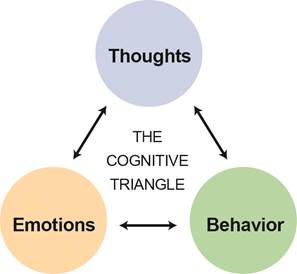
So..... this month I want to spend some time discussing Cognitive Behavior Therapy (CBT). We will first examine what CBT is and the basic philosophy that forms its foundation. Then in the next blog in June, I will show how I have integrated CBT with the other approaches to addressing behavior and academic issues that we have all experienced, both parents and educators. Let me say upfront, that while I have many hours of training with CBT and hope to continue traveling to the Beck Institute, I am not a therapist. Therefore, my understanding of CBT and its application is from a lay perspective. Often, during classes in CBT at the Beck Institute in Philadelphia, PA, I was the only non-therapist in the course. My concerns and my questions were often very different from the health care professionals. The first aspect of CBT that I want to share is the Cognitive Triangle or Cognitive M...
Blog 3-May,2018

☺☺ Did you have an opportunity to listen to Rita Pierson on You Tube in the last Blog? This is not her only video, but it is one of my favorite. Unfortunately, she died in 2013. It was sad for me as I feel she had wisdom that she had not yet shared. I encourage you to look up her other videos and watch them. She was an inspiring woman who combined wisdom and humor. You won't be disappointed. Remember, we are discussing building self-confidence in our students. Albert Bandura referred to it as self-efficacy. Rita said it so well when she asks, "Do you think you will like all your kids? Of course not!!!! But they can never know it." Think about all the kids who say they "can't do it". Think back to a time when you were unsure of yourself. When you were afraid to try something new: maybe tackle a project, take a test, enter a competition. Who inspired you with the confidence to move forward?...
Blog 2-May, 2018

Blog 2 May, 2018 One of the important considerations from the video we viewed, I believe, is the positive perception of self depicted in the video by each of the students. Did you think to yourself, “ These kids are so comfortable with their 'differences' and seemed to be able to advocate for themselves in positive and constructive ways?" Albert Bandura (1999) believed that each person's perception of himself can have an effect on how well we learn, how successful we will be in life and how we interpret life events. He called this concept Self-Efficacy. Self-Efficacy can effect our ability to sustain effort and to achieve, our ability to confront difficult tasks and our reaction to constructive criticism as well as how we diffuse stress and interpret threats. When we are exposed to criticism and name calling on a regular basis, when we are discouraged from pursuing a challenge, and when our inquiries go unanswered, we develop a negative sense of se...
First Blog

I have so many ideas as to what I want to share on this site, it was difficult to pinpoint one. But I decided to go with a video on youtube that I have used many times in workshops. It speaks to multiple levels of teaching from classroom management to differentiated learning; from building personal relationships with students, the impact of culture in the classroom, to working with parents. I hope you will take the time to view it now, before you read further. If you have seen it already, please view it again with virgin eyes before you read on. So what do you think? Did you take any notes? Here are some impressions from others and from me as we watched the video. Please post yours as well. Would I be able to accommodate the needs of all these students in my class: A student who needs to rock with someone who needs to walk; a student who needs t...